Showing posts with label Carburetor. Show all posts

Thursday, April 2, 2009

What's new with the engine?

Not much. In fact most of it's pretty damned old. There's gunk on/in that block that's probably twice my age. Lots of it... and it's thick and nasty. The deeper we dig into this car, the more we are coming to realize that it is a living testament to the quality of old school American engineering. I've lost count of how many times I've stopped, looked, and thought "Damn... all that and it still runs."

We've been busy up in the engine compartment. A previous post mentioned that the carb had come off, and it's now disassembled and mostly clean. Turns out the shaft that hold the choke valve and connects it to all the linkages that control choke was busted beyond repair, which might have been a deal killer for that carburetor. Dad managed some pretty impressive networking though, and found a shop in Mount Vernon run by Terry, who's an expert on these things. We paid Terry a visit last week and ended up buying a beat up top end off a similar carb from him for $20. It just happened to have a shaft of the right length, with the right cuts in it, and dad was able to drill and tap the necessary holes in the end to attach us to all the linkages. So my friends, it looks like we're keeping our carb. :)

In other news outside the block, a closer look at the radiator revealed it to be in rough shape. Still holding most of it's fluid, but leaky, and definitely looking shaky on the inside (read: thick brown sludge on everything.) We yanked it out last weekend, and it's now in a shop in Bellingham being rebuilt. Along with it, dad took the alternator, which has passed a professional inspection and looks sound, so it'll be getting shined up in dad's shop. And then there's the things attached directly to the block...


No Radiator?

Let's start with the exhaust manifold. We noticed early on that it was missing some bolts. As it turns out it was missing most of it's bolts. Dad will have to fill in the blank on the exact number holding it in place, but it wasn't many. There are some other bolts missing from other parts of the car too, but lets stick with the exhaust for now. We always knew the manifolds would need to come out, and when we finally yanked them, there were no gaskets either. Awesome. Those are getting the spa treatment in Bellingham currently.

After a fair amount of deliberating, we decided it would probably be best if we took a look inside the top end before we tried to run it again. So next the intake manifold came off, and I'd say we were immediately validated in our decision. Unbelievable crap has accumulated in the gallery. Thick gooey, chunky crap. Looking down the passages into the heads, the air intakes look rusty, but okay; however, the water passages are filled with the same brown sludge that's in the radiator. There's an exhaust crossover passage that is meant to warm up the manifold, and that's pretty black, but no surprises there.

And finally, tonight I pulled the valve covers off. More of that grimy gunk. Piles of it. Quarter inch deep in some places. And this in and around all the valve levers & such. It is amazing that this car fired up and ran with all this crap in it's guts. It's hard to do the image justice with a snapshot picture, but this one shows some of the gunk:


Sunday, March 8, 2009

Carburetor Out

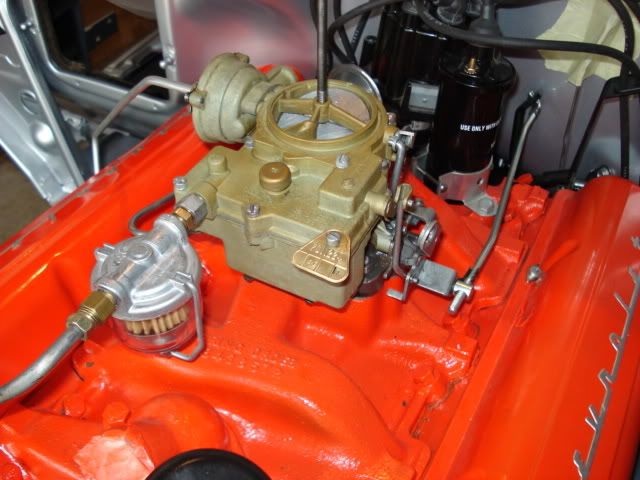
Took the carburetor out Saturday night. It was a pretty straight forward affair. All the nuts broke easy, and only one was hard to get at, being tucked in a recess behind the float bowl. Once I got it off, I was able to get a closer look at the body, to try and find ID markings and such. Rochester carburetors from that era came from the factory with a triangular tag under one of the float bowl screws. If that tag is gone (which ours is,) you basically have to go get access to GM's blueprints to figure out exactly what model you've got. This pic of a nicely restored '57 shows exactly what we're missing:


I did find a casting number on the base plate that read "GM195812," and I'd say it's a pretty safe bet that means it was made in 1958. That adds to my conviction that the engine we've got came out of a 1958 Chevy. The stamped number on the engine block reads "F0605D," and that D-suffix means it's a 283 from either a 1958 or a 1960. We might need to invest in a 1958 engine manual, since there are definitely some differences from what's described in the '57 literature, though mostly minor.

I've been reading up on the operation of these carbs, and I think one of the big contributions to our engine issues (tons of smoke, rough running, some knocking) is that the tube that connects the automatic choke contraption to the exhaust manifold is missing, and looks like it's been missing for a while. Without it, the thermostat coil in the choke doesn't heat up, so the choke valve doesn't open as intended. Basically we've been running at full choke, cold or not, which would explain why it acts like the mixture is rich. :)

Today I cleaned up the interface on the intake manifold, scraped off the old gasket, etc. Part of it still has a nice machined finish, but a section in the front is pitted out. The two front studs are also corroded & missing some threads at the bottom. Those will require some care. There was also a little damper/dashpot/god-knows-what attached to front left stud that looks like it was intended to be a part of the linkage system, but definitely wasn't doing anything useful recently. That thing was one of the reasons for the missing threads. Here's a pic of it, any speculation as to what it's for is welcome:

From Exhaust, Carb Out, & Wheel Checkout